
Published on November 6, 2026
Dark Project Ransomware Gang Claims 38 Victims Across 8 Countries, Targeting Healthcare and Manufacturing
Severity
Medium
Dark Project is an emerging financially motivated ransomware group that reportedly claimed 38 victims across eight countries, according to the supplied threat intelligence dataset. Manufacturing was the most affected sector with 12 victims, followed by healthcare with seven and construction with four. These figures are based on disclosures published through the group’s criminal infrastructure and have not been independently verified.
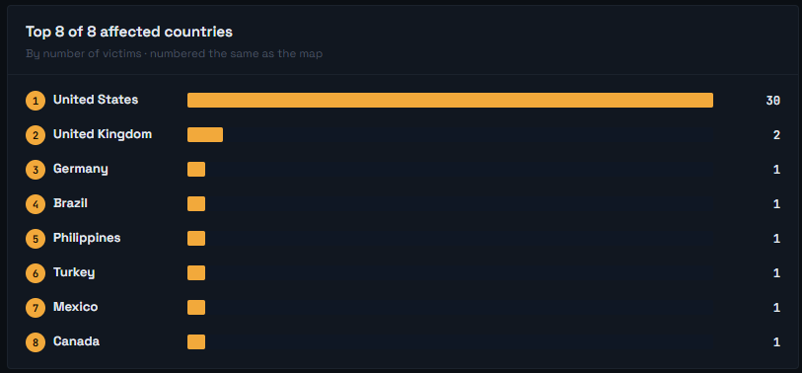
The United States accounted for the highest number of reported victims, with 30 organizations, followed by the United Kingdom with two. Germany, Brazil, the Philippines, Turkey, Mexico, and Canada each recorded one victim. The group’s activity reportedly began in June 2026, with a significant increase in victim disclosures during August, which recorded 20 listings. However, other public trackers identify August as the group’s emergence, leaving the earlier activity timeline uncorroborated. Dark Project operates under a ransomware-as-a-service (RaaS) model, offering affiliates an advertised 80% commission while retaining 20% for platform services. Bitcoin is listed as its preferred ransom payment method.
How?
Dark Project employs a double-extortion technique by stealing sensitive information before encrypting victims’ systems. It then threatens to publish the stolen data through its Tor-based leak portal if the ransom demands are not met. The group reportedly gains initial access through phishing, exposed Remote Desktop Protocol (RDP) services, compromised credentials, and VPN access obtained through infostealer logs or access brokers.
Its RaaS operation separates intrusion activities from extortion management. Affiliates are responsible for deploying ransomware payloads, while the main operators handle victim communications and ransom negotiations. The advertised infrastructure includes a Tor-hosted affiliate dashboard, EXE and BIN payloads containing affiliate identifiers, and social engineering tools. Associated MITRE ATT&CK techniques include Windows Management Instrumentation (WMI), Server Message Block (SMB), credential abuse, data exfiltration, file encryption, and recovery inhibition.
Recommendation
- Ensure internet-facing systems, VPN gateways, and RDP services are properly secured and regularly patched.
- Enforce Multi-Factor Authentication (MFA), particularly for remote access and privileged accounts.
- Monitor suspicious login activities, unusual WMI and SMB usage, and abnormal data transfers that may indicate lateral movement or data exfiltration.
- Implement EDR and SIEM monitoring to detect ransomware activities, credential abuse, and suspicious encryption behaviour.
- Maintain regular offline or immutable backups and periodically test recovery procedures.
- Conduct phishing awareness training and strengthen email security controls to reduce the risk of initial compromise.
Conclusion
Dark Project presents a growing ransomware threat through its RaaS affiliate model and double-extortion capabilities. Its reliance on multiple initial access methods and centralized extortion operations allows affiliates to conduct attacks while reducing the operational burden on the main operators. Organizations should strengthen remote access security, monitor suspicious activities, and maintain reliable backup and recovery mechanisms to minimize the risk and impact of ransomware incidents.
Source